Beetle ESP32-C6
✅ Active ✅ Deployed
board DFRobot Model: Beetle ESP32 C6 📅 Acquired: Sept 2024
DFRobot Beetle ESP32-C6 Development Board
📅Last updated:January 22, 2026(10 days ago)
🚀 Used in Projects (2)
Bedroom Climate Controller with Touch Interface ⏸️ Abandoned
Bedroom Climate Controller ✅ Completed
Connection Types
🔲 See This Board in Action
This board is featured in our interactive size comparison.
Overview
The DFRobot Beetle ESP32-C6 is a compact development board based on the ESP32-C6 chip, featuring WiFi 6 and Bluetooth 5.3 connectivity in a small form factor. It also features Zigbee 3.0 and Thread 1.3.
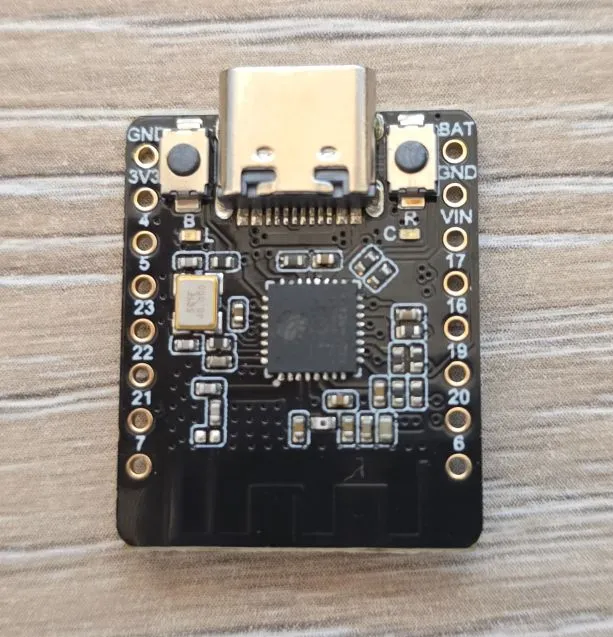
Additonal Hardware features
- LED GPIO15
- Boot Button GPIO9
Test Status
- ✅ Basic Config + Internal LED & Boot Button
- ✅ GPIO - output: Internal LED, input: Boot Button
- UART
- SPI
- I2C
- I2S
- (LED) PWM
- IR
- ADC
- Temperature Sensor
- Parallel I/O
Basic Configuration
Basic configuration with built in button and LED.
esphome:
  name: my-esp32c6

esp32:
  variant: esp32c6

output:
  - platform: gpio
    pin: GPIO15
    id: builtin_led

light:
  - platform: binary
    name: "Built in LED"
    output: builtin_led

binary_sensor:
  - platform: gpio
    pin:
      number: GPIO09
      inverted: true
    id: boot_btn
    on_press:
      then:
        - output.turn_on: builtin_led
    on_release:
      then:
        - output.turn_off: builtin_led
Features
- Compact Design: Ultra-small size perfect for space-constrained projects
- Modern Connectivity: WiFi 6 (802.11ax 2.4GHz) and Bluetooth 5.3 with LE support
- USB-C Interface: Easy programming and power via USB Type-C
- Debugging: JTAG & Serial Debugging over USB
- Low Power: Excellent power efficiency with multiple sleep modes
- Peripherals:
- Digital I/O x13
- LED PWM 6 Channel
- SPI x1
- UART x3 (LP UART x1)
- I2C x2 (LP I2C x1)
- I2S x1
- IR Transceiver: transmit channel x2, receive channel x2
- 1 × 12-bit SAR ADC, 7 Channel
- DMA Controller: transmit channel x3, receive channel x3
Pin Reference
The Beetle ESP32-C6 provides access to various GPIO pins. Refer to the board’s pinout diagram for specific pin assignments.
Common Pin Mappings
- I2C: GPI19 (SDA), GPI20 (SCL)
- SPI: GPIO22 (MOSI), GPIO21 (MISO), GPIO23 (SCK)
Power Considerations
The Beetle ESP32-C6 can be powered via:
- USB-C: 5V power supply
- Battery: Connect to battery pins (check polarity)
- 3.3V Pin: Direct 3.3V regulated power
Notes
- The ESP32-C6 uses a RISC-V architecture (not Xtensa like older ESP32 models)
- ESP-IDF framework is recommended for ESP32-C6 support
- WiFi 6 features provide improved performance and efficiency
- Lower power consumption compared to older ESP32 variants
Other Images
Beetle ESP32-C6 back:
